
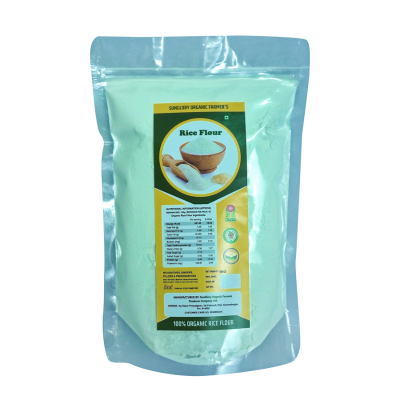
Rice Flour (Tandul Peeth)
Weight
Choose options
Weight
Weight
Rice flour milled from our own rice, known as tandul peeth in Marathi kitchens. It is a fine white flour with no gluten, and it behaves like a starch rather than a dough, which is what makes it useful when you want something crisp.
Most rice flour on a shop shelf is ground from broken rice bought cheap by the tonne. Ours is milled from whole grain that our farmer members grew, in small lots, so it smells clean instead of musty.
Where it earns its place
Ghavan, the thin Konkan pancake, asks for nothing beyond this flour, water and salt. Ukad for modak is the other classic, where boiling water is beaten into the flour to make a soft dough. Past that it thickens an amti, gives papad and kurdai their snap, and a spoonful stirred into bhajji batter is the old trick for a coating that stays crisp after it cools.
Pack sizes and storage
1kg, 2kg, 3kg, 4kg and 5kg. Keep it dry and airtight and it holds for two to three months. If it cakes in the monsoon, dry roast it lightly and sieve.
Mix it with jowar flour for a softer bhakri, or read through the full list of grains and flours.
Frequently asked questions
Can I make chapati with rice flour
Not a soft rolled chapati, because there is no gluten to hold it together. What you can make is rice bhakri, patted from a dough kneaded with boiling water.
Is rice flour the same as rice starch
No. Rice flour is the whole grain ground fine, while starch is only the extracted portion. The flour keeps the protein and a trace of bran, so it tastes of rice while starch tastes of nothing.
Why does my ghavan tear when I spread it
Either the batter is too thin or the tawa is too hot. Aim for a batter that just coats the back of a spoon and pour it onto a medium hot pan in one movement.


